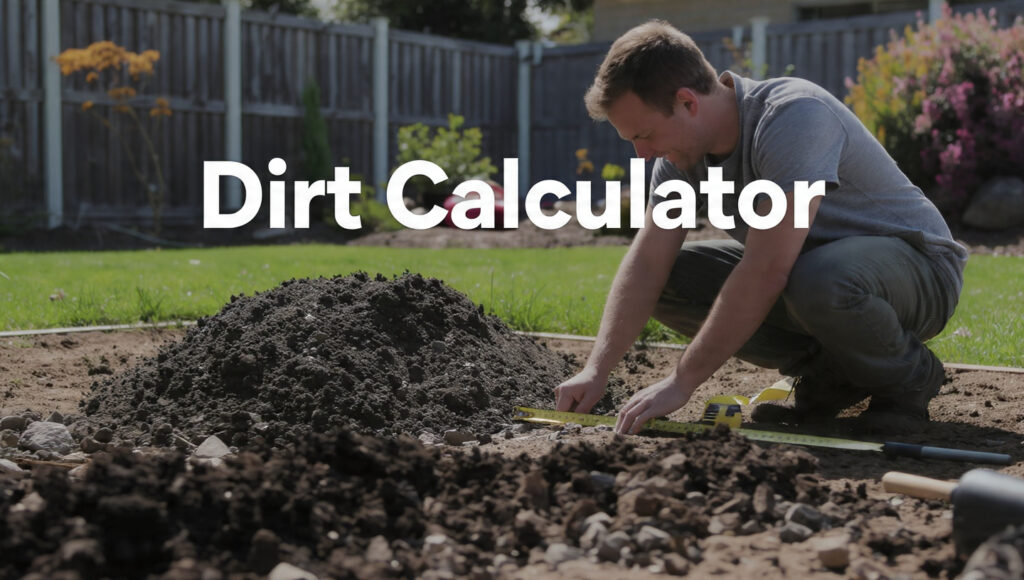
Buying too little soil can delay your project. Buying too much wastes money and storage space. That’s where a Dirt Calculator becomes essential.
Our easy-to-use Dirt Calculator helps you estimate the exact amount of soil, fill dirt, sand, or gravel you need in just seconds. No complicated math. No guesswork. Just clear and accurate results.
In this detailed guide, you’ll learn:
- What a Dirt Calculator is
- Why it matters for landscaping and construction
- The formula behind it
- How to calculate manually
- Real-life examples
- Common mistakes to avoid
- Expert tips for accurate results
Let’s get started.
What is Dirt Calculator?
A Dirt Calculator is an online tool that estimates the volume of soil or fill material needed for a specific area.
It calculates:
- Cubic yards
- Cubic feet
- Cubic meters
- Tons (when density is included)
You simply enter:
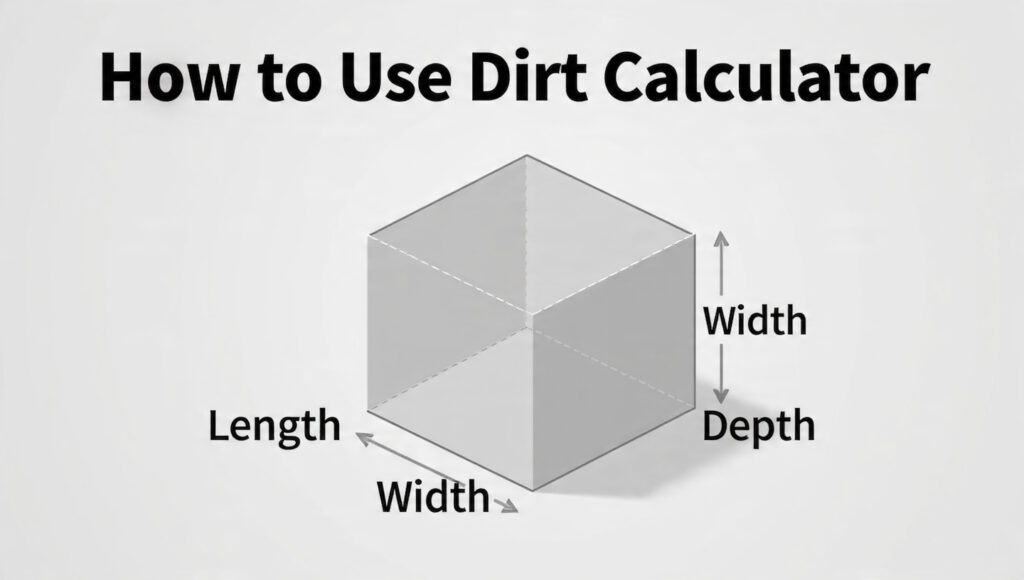
- Length
- Width
- Depth
The calculator instantly provides the total volume required.
This tool is commonly used for:
- Landscaping projects
- Construction foundations
- Raised garden beds
- Driveway base layers
- Leveling uneven ground
Instead of guessing, you get a reliable estimate based on math and measurements.
Why is Dirt Calculator Important?
Many people underestimate the importance of accurate soil calculation. However, small mistakes can lead to major problems.
Here’s why using a Dirt Calculator is important:
1. Prevents Overspending
Buying extra dirt costs money. Suppliers often sell in bulk, so overestimating by just a few cubic yards can increase your expenses significantly.
2. Avoids Project Delays
Underestimating means placing another order. That means waiting for delivery and possibly pausing your project.
3. Improves Planning
Accurate estimates help you:
- Budget correctly
- Plan transportation
- Schedule labor efficiently
4. Reduces Waste
Excess soil often goes unused. That creates waste and disposal problems.
In short, a Dirt Calculator saves time, money, and effort.
How to Use the Dirt Calculator (Step-by-Step Guide)
Using our Dirt Calculator is simple. Follow these steps:
Step 1: Measure the Area
Use a measuring tape to record:
- Length
- Width
- Depth
Always measure in the same unit (feet, meters, or inches).
Step 2: Enter the Values
Input your measurements into the calculator fields.
Step 3: Select Unit
Choose your preferred output unit:
- Cubic yards
- Cubic feet
- Cubic meters
Step 4: Click Calculate
The Dirt Calculator instantly shows the required volume.
Step 5: Add Extra (Optional)
Experts recommend adding 5–10% extra for compaction and settling.
That’s it. No manual calculations required.
Formula Behind the Dirt Calculator
Understanding the formula helps you trust the result.
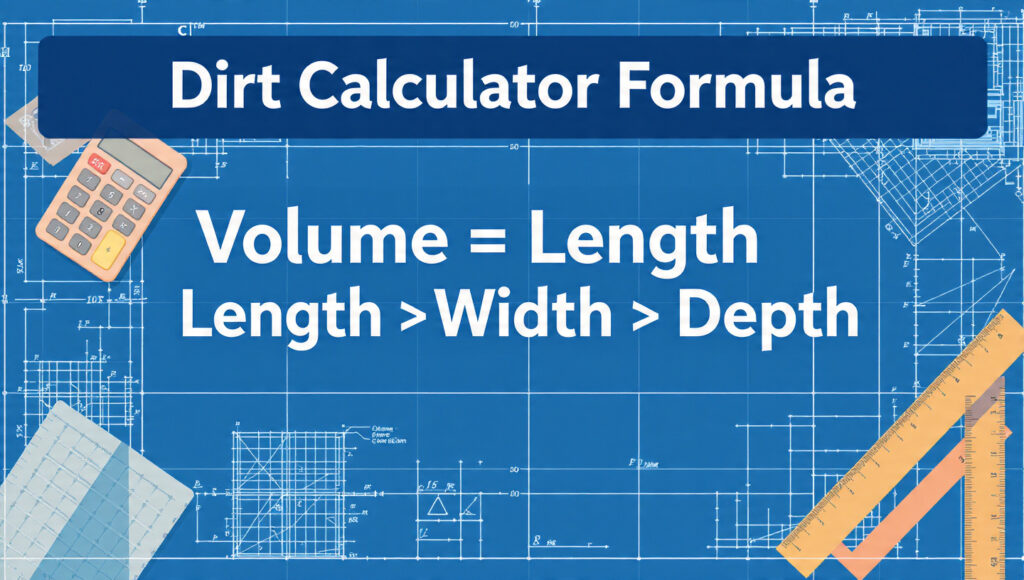
The basic volume formula is:
Volume = Length × Width × Depth
For rectangular areas:
Cubic Feet = L × W × D
To convert cubic feet into cubic yards:
Cubic Yards = Cubic Feet ÷ 27
(1 cubic yard = 27 cubic feet)
For circular areas:
Volume = π × Radius² × Depth
Where:
- π ≈ 3.1416
- Radius = Diameter ÷ 2
The Dirt Calculator automatically performs these conversions.
Manual Calculation Method (Educational Purpose)
If you want to calculate dirt manually, follow this example.
Example:
Length = 20 feet
Width = 10 feet
Depth = 0.5 feet (6 inches)
Step 1: Multiply
20 × 10 × 0.5 = 100 cubic feet
Step 2: Convert to cubic yards
100 ÷ 27 = 3.7 cubic yards
You would need approximately 4 cubic yards of dirt.
Manual calculation is helpful for learning. However, the Dirt Calculator makes it much faster and reduces mistakes.
Features of Our Dirt Calculator
Our Dirt Calculator is designed for simplicity and accuracy.
Key features include:
- Instant volume calculation
- Multiple unit conversions
- Works for rectangular and circular areas
- Mobile-friendly design
- No sign-up required
- Free to use
- Fast loading speed
- Clear results display
It works smoothly for students, professionals, and homeowners.
Benefits of Using This Dirt Calculator
Using a Dirt Calculator offers several advantages:
Accuracy
Precise math reduces human error.
Time-Saving
Get results within seconds.
Cost Control
Buy the right amount of soil.
Easy for Beginners
No math skills required.
Suitable for Many Materials
You can estimate:
- Topsoil
- Fill dirt
- Sand
- Gravel
- Compost
- Mulch
This flexibility makes it a practical tool for many projects.
Real-Life Examples
Let’s look at three practical examples.
Example 1: Backyard Garden Bed
Sarah wants to build a raised garden bed.
Measurements:
- Length: 12 feet
- Width: 4 feet
- Depth: 1 foot
Calculation:
12 × 4 × 1 = 48 cubic feet
Convert:
48 ÷ 27 = 1.78 cubic yards
She should order about 2 cubic yards of soil.
Example 2: Driveway Base Layer
John is installing a gravel base.
Measurements:
- Length: 30 feet
- Width: 12 feet
- Depth: 0.5 feet
Calculation:
30 × 12 × 0.5 = 180 cubic feet
Convert:
180 ÷ 27 = 6.67 cubic yards
He should order 7 cubic yards of gravel.
Example 3: Leveling Uneven Ground
A small business owner needs to level a 20 × 20 area.
Depth required: 0.25 feet
Calculation:
20 × 20 × 0.25 = 100 cubic feet
Convert:
100 ÷ 27 = 3.7 cubic yards
About 4 cubic yards will be needed.
Common Mistakes to Avoid
Even with a Dirt Calculator, mistakes can happen.
Avoid these:
1. Wrong Unit Conversion
Mixing feet and inches causes errors.
2. Ignoring Compaction
Soil settles after spreading.
3. Not Measuring Depth Properly
Depth should be consistent across the area.
4. Forgetting Irregular Shapes
Break irregular spaces into smaller rectangles.
Who Should Use This Calculator?
The Dirt Calculator is helpful for:
- Homeowners
- Gardeners
- Landscapers
- Construction workers
- Contractors
- Students learning volume formulas
- Business owners managing site work
Anyone working with soil or fill material can benefit.
Comparison with Manual Calculation
| Factor | Manual Method | Dirt Calculator |
|---|---|---|
| Speed | Slow | Instant |
| Error Risk | High | Very Low |
| Conversion | Manual | Automatic |
| Ease | Moderate | Very Easy |
| Accuracy | Depends on user | Consistent |
The calculator clearly provides more convenience.
Advantages Over Other Online Tools
Our Dirt Calculator stands out because:
- Clean, simple interface
- No pop-up overload
- Fast calculation engine
- Accurate unit conversion
- Designed for all experience levels
- Privacy-focused usage
Some tools require sign-ups or show confusing results. Ours keeps it simple and clear.
Frequently Asked Questions (FAQs)
1. What is the difference between topsoil and fill dirt?
Topsoil contains nutrients for plants. Fill dirt is used mainly for leveling and construction.
2. How accurate is the Dirt Calculator?
It provides mathematically accurate results based on the measurements you enter.
3. Should I order extra dirt?
Yes. Add 5–10% extra for settling and compaction.
4. Can I use this for sand or gravel?
Yes. The calculator works for any material measured by volume.
5. What unit should I choose?
Most suppliers sell by cubic yards. Check with your supplier before ordering.
6. Does moisture affect volume?
Wet soil can be heavier and compact differently, but volume calculation remains the same.
7. Can I calculate irregular areas?
Yes. Divide the space into smaller rectangles and calculate separately.
Pro Tips for Accurate Results
- Measure twice before entering numbers.
- Convert inches into feet (12 inches = 1 foot).
- Add extra material for uneven surfaces.
- Confirm supplier measurement units.
- Consider soil settling over time.
- Use consistent units throughout calculation.
These small steps improve accuracy significantly.
Understanding Soil Types and Density
Different materials have different densities.
Approximate weights per cubic yard:
- Topsoil: 2,000–2,700 lbs
- Sand: 2,600–3,000 lbs
- Gravel: 2,400–2,900 lbs
If you need weight estimates, multiply volume by material density.
Always check with your local supplier for accurate weight values.
When to Consult a Professional
While a Dirt Calculator is helpful, some projects require expert guidance.
Consider professional advice for:
- Large commercial construction
- Drainage systems
- Foundation filling
- Structural landscaping
Complex projects may require engineering evaluation.
Disclaimer
This Dirt Calculator provides volume estimates based on user input. Results are intended for general planning and educational purposes only.
Actual material requirements may vary due to soil compaction, moisture content, ground conditions, and project specifications. Always confirm measurements with your supplier or contractor before making large purchases.
Privacy & Data Safety Statement
We respect your privacy.
Our Dirt Calculator does not store, track, or share your entered measurements. All calculations are performed instantly and are not saved in any database.
Your project information remains completely private.
Internal Linking Suggestions
You can link this article to:
- Concrete Calculator
- Gravel Calculator
- Mulch Calculator
- Square Footage Calculator
- Volume Calculator
These tools help users with related construction and landscaping needs.
External Authority Reference Suggestions
For educational credibility, consider referencing:
- Local building code guidelines
- University agricultural extensions
- Landscaping material suppliers
- Construction estimation textbooks
- Civil engineering resources
These references improve trust and reliability.
Conclusion: Make Every Project Accurate with a Dirt Calculator
Planning a landscaping or construction project does not have to be stressful.
With the help of a Dirt Calculator, you can:
- Estimate soil volume accurately
- Save money
- Avoid delays
- Reduce waste
- Plan confidently
Whether you are a student learning measurements, a homeowner improving your yard, or a contractor managing a job site, this tool simplifies your work.
Try the Dirt Calculator today and take the guesswork out of your next project. Accurate planning starts with accurate numbers.